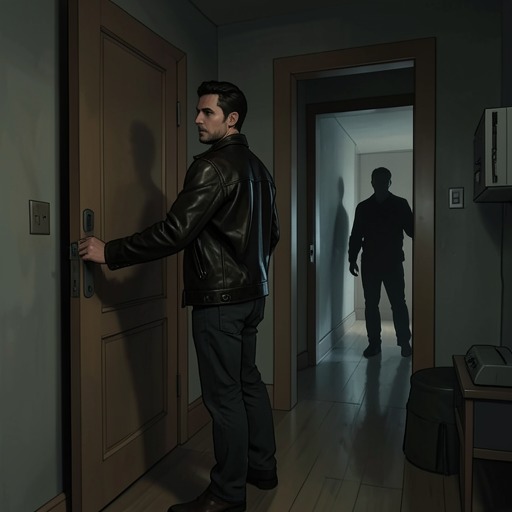
Matt Hunter and Charles Talley’s Hostility
The InnocentMatt Hunter and Charles Talley’s hostility begins as a digitally mediated suspicion and becomes a direct threat: Matt identifies Talley in a phone image, links him to a car that appears near Matt’s office and elsewhere, and hears him boast about Olivia. The conflict is more than a rivalry between two men. It tests what images can establish, exposes the fragility of Matt’s trust in his marriage, and turns his own criminal record into a measure of how easily suspicion can be shaped by prejudice.
Identification and the first clues
Matt first notices the gray Ford Taurus while turning away from a scene at which he has been helping Pastor Jill. The car is about thirty yards behind him. Its color and model alone would mean little, since such cars are common; the license plate, MLH-472, catches his attention because its letters resemble his own initials. Matt recognizes the vehicle as the same one he had seen outside his office. The recurrence is suggestive, not proof, and his effort to allow for coincidence shows how carefully he tries to contain his suspicion even as the details accumulate.
A later inquiry ties the car to Talley. Cingle Shaker contacts the airport and discovers that the vehicle was rented by Charles Talley, a name Matt initially says he does not recognize. Cingle also tells Matt that Talley has a record for assault involving brass knuckles. Matt’s instinct is to compare that history with his own, but he recognizes the unequal weight given to criminal records: his record has been used against him, while the seriousness of Talley’s can make him a person of interest. That contrast makes the investigation personal as well as evidentiary.
Phone images and the problem of proof
The camera phone supplies the most intimate and destabilizing evidence. When Matt receives a photograph, he finds it unusual that Olivia is sending it: although she works in the computer business, she is inexperienced with the phone’s camera feature and ordinarily calls him at the office landline. A video then appears, but the display is shaky and the clip is expected to last only seconds. The technology conveys information while limiting confidence in what it shows; the image must be interpreted rather than simply accepted as transparent fact.
Cingle’s presentation of Talley’s mug shots changes Matt’s reaction. On seeing the front and profile photographs, Matt recognizes the same man and the same distinctive smirk from the camera-phone material. His recognition converts an indistinct image into a named adversary, but it also intensifies the stakes of the evidence: the phone image is no longer an anonymous disturbance but a possible link between Olivia, Talley, and the car.
Matt later examines another image for a concrete inconsistency. He can tell that the car in the phone picture is gray, but notices raindrops on the window. Since the image was sent the previous day and the weather had not been rainy that day or the day before, the droplets undermine the apparent timing of the picture. This discrepancy makes the images less reliable as straightforward records and sharpens the distinction between what they depict and what someone wants Matt to infer from them.
Talley’s call and Matt’s response
The hostility becomes explicit during a call from an unavailable number. Matt is discussing a legal case when a man whispers that he is doing something with Matt’s wife. The caller’s words provoke Matt into naming Talley and threatening him. Talley does not answer with an explanation; he says he must go because Olivia is returning, then ends the call. His taunt supplies a direct personal provocation, but it does not settle what the images show or establish the full circumstances of his relationship with Olivia.
Matt’s immediate response is to cancel his afternoon appointments, though his assistant points out that he has none. The small exchange registers how thoroughly the call has displaced ordinary work: he reacts as if he must clear his day for what comes next. At home, he searches Olivia’s email, including old messages, sent mail, deleted mail, and browser history. The folders and history have been cleared, leaving him without the digital trail he hoped might explain events. His use of her password marks a further breach of trust: in trying to verify what Talley has implied, Matt turns suspicion into surveillance of his wife.
He also drinks vodka at a bar, first ordering one and then another. The drinking makes him feel less rather than resolving what he knows. Matt feels uncomfortable both in his former, gentler world and in the harder one associated with his prison experience; at this point, being with Olivia is the only place he feels at ease, which makes Talley’s intrusion especially destabilizing. His anger and his need for Olivia coexist with the fact that he has begun investigating her in secret.
Hostility within the wider story
Matt’s conflict with Talley unfolds against the larger rupture in Matt and Olivia’s marriage. Olivia eventually tells Matt that everything she has told him about herself was a lie, beginning with her supposed upbringing in Northways and education at the University of Virginia. That disclosure reframes the couple’s trust as a broader crisis of identity and concealment, rather than a question about one phone image alone. It does not erase Talley’s threat, but it makes clear that Matt’s search for certainty is taking place within a relationship built partly on invented history.
The hostility therefore develops through competing forms of evidence: a car and license plate, a brief phone video, mug shots, a timing inconsistency in a photograph, a taunting call, and email and browser records that have been erased. Each item changes Matt’s understanding, but none initially delivers a complete account. Talley’s known assault record and his deliberate provocation make him a credible danger to Matt; Matt’s own record, meanwhile, makes him acutely aware that a label can shape how others interpret conduct. The conflict’s defining tension is the distance between suspicion and proof, and the way that distance is narrowed by anger even as the available digital evidence remains incomplete.